
You can operate in freight for years without knowing what Form BOC-3 is. Right up until the day you need to serve someone, get served, protest an authority, or explain to a shipper why a “real carrier” on paper turned into a ghost the moment the load went sideways.
We’re compliance people at Indemni. We deal with brokers who are buried in FMCSA rules and random admin tasks that feel pointless. Form BOC-3 is one of the few that actually has teeth. Not “paperwork.” A control.
What a BOC-3 filing is
A BOC-3 is the FMCSA “Designation of Agents for Service of Process” meaning a carrier, broker, or freight forwarder names a process agent (or blanket agent network) who can receive court papers and legal notices on their behalf in the states they operate or do business in, and FMCSA expects it on file to obtain and keep active registration.
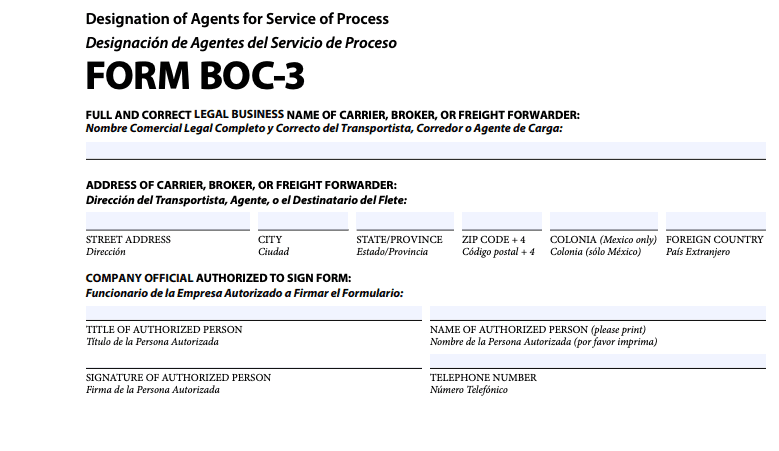
Who needs a BOC-3 and when
If you are a motor carrier, broker, or freight forwarder subject to FMCSA registration, you generally need a BOC-3 on file as part of registration, and failing to file can lead to deactivation of the USDOT number under the FMCSA process-agent rules, because the designation is treated as a required condition of active registration.
The main reference is 49 CFR Part 366 (Designation of Process Agent). The eCFR language explicitly ties filing to registration timing and says failure to file results in deactivation.
Why is the BOC-3 so important
A BOC-3 is a legal accountability mechanism because it makes every registered entity maintain a reachable, verifiable service-of-process path that stays valid while their registration stays active.
FMCSA’s own policy posture is that an invalid or inaccurate process-agent designation is not a harmless clerical issue but grounds for suspending or deactivating operating authority registration. At the end of the day, it’s important from an accountability standpoint that in any state, there is a mechanism and a way for any legal issue to find its way to the company in that state.
BOC-3 doesn’t “prevent” fraud by itself. It does something more boring and, more powerful: it makes it harder to be un-findable while still holding active authority.
FMCSA’s policy statement on invalid BOC-3 filings is blunt: entities must maintain an accurate designation on file to keep registration active, and FMCSA interprets the rules to require a valid designation “at all times” for operating authority registration to remain active.
If it’s wrong, registration can get pulled out from under you.
How to file a BOC-3 in 2026
In 2026, BOC-3 filing is still handled through FMCSA’s systems and typically submitted electronically by a registered process agent (especially for motor carriers), and you should plan for it as a gating item for authority activation since FMCSA’s registration guidance ties operating authority to having BOC-3 and insurance filings in place, with FMCSA also shifting filers toward portal and Login.gov workflows. However, as time goes, this may change as we move to a new system such as MOTUS.
Step-by-step
You pick a process-agent service (blanket agent is the common route), they submit the BOC-3 electronically, you retain a copy, and any changes in your legal name/address/agent should be immediately flagged for an update. FMCSA expects the designation to stay accurate while registration stays active.
Steps:
- Confirm your entity type and what you’re registering as (motor carrier vs broker vs freight forwarder).
- Choose a process agent or blanket agent service that can cover the states you need.
- Have the BOC-3 filed electronically (for motor carriers, FMCSA says the process agent files it).
- Keep a copy at your principal place of business (FMCSA expects this).
- Keep it accurate over time. FMCSA’s policy stance treats invalid/inaccurate filings as registration-risk.
How brokers should use BOC-3 in carrier vetting
For brokers, the BOC-3 matters because it is one of the few FMCSA registration artifacts that directly ties a carrier’s authority to an ongoing, reachable legal endpoint, and even if you never personally serve papers, understanding the process-agent requirement helps you spot sketchy setups, ask for the right proof, and avoid treating “active authority” as the same thing as “operationally accountable.”
This is where we got “curious” ourselves: brokers kept hearing “you need it” without hearing “here’s what it protects.” So we started explaining it like a control, not a checkbox.
What you can actually verify (without pretending you’re a lawyer)
FMCSA tells the public to use the Licensing & Insurance (L&I) system to look up a motor carrier, broker, or freight forwarder’s operating authority. That’s your baseline: authority status, insurance filings, bond where relevant, and the paper trail that FMCSA exposes.
BOC-3 itself is tricky because “can I see the carrier’s exact agent list” is not always a clean, public, one-click answer in the way people assume. So we use a two-track approach:
Track A (FMCSA data): Confirm authority and related filings using FMCSA L&I, because that’s the system FMCSA points you to for authority checks.
Track B (carrier-provided evidence): Ask the carrier for their BOC-3 confirmation/copy and cross-check basic consistency (entity name, docket/US DOT linkage, filing service name, date). FMCSA expects the entity to retain a copy anyway.
If a carrier can’t produce a copy at all, and they’re “active,” you just learned something about how they run compliance. Sometimes it’s innocent. Sometimes it’s the whole story.
Two broker-specific gotchas
1) Brokers have BOC-3 obligations too. FMCSA explicitly says brokers are required to list process agents in each state where they have an office and where they write contracts.If you’re growing across states and signing contracts in new places, treat this like corporate hygiene, not an afterthought.
2) “We have a BOC-3” is not the same as “our filing is valid today.” FMCSA’s policy posture is about maintaining an accurate designation to keep registration active. So your vendor onboarding question isn’t just “did you ever file one,” it’s “is your filing current, and does it match your actual legal footprint.”
Failure modes
Most BOC-3 problems are boring until they’re expensive, and the common failures are predictable: wrong legal name after an entity change, outdated addresses, mismatched docket/authority details, assuming the filing “sticks forever,” or using a low-quality filing service that makes it hard to update quickly when something changes.
Examples include:
- Entity name drift: “DBA looks fine” while the legal name on filings doesn’t match, and now you’ve got a records mismatch across systems.
- Agent churn without updates: someone swaps services, cancels, or changes coverage, and nobody files the replacement.
- Assuming it’s a one-time activation step: FMCSA’s stance is continuous validity, not a one-and-done.
- Broker expansion blind spot: new offices, more states, more contracts, no update to agent listings (then you get served in a state you didn’t think “counted”).
If you want a simple internal rule: anytime you change your legal name, principal address, or corporate structure, you do a quick “registration artifacts check” and BOC-3 is on that checklist.