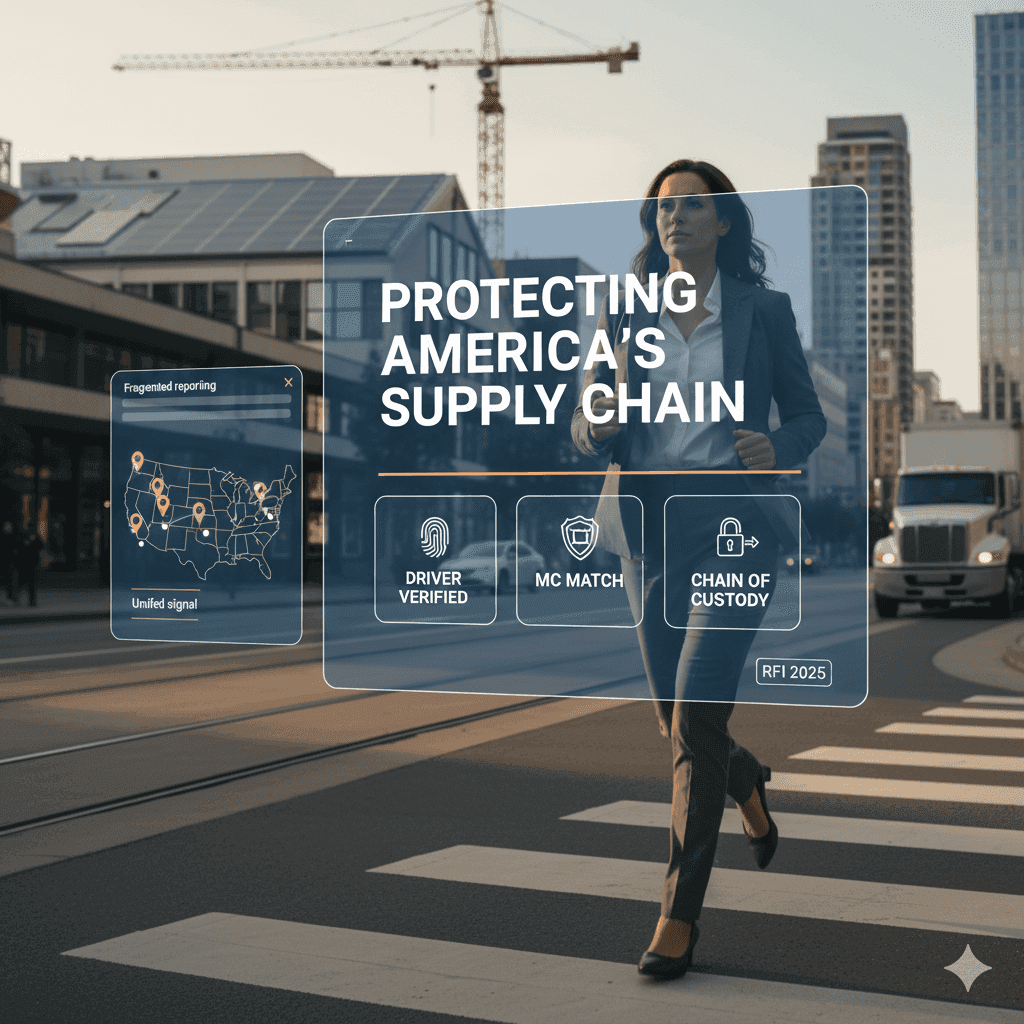
The U.S. supply chain has become increasingly volatile in recent years. Rising rates, tighter capacity, and widespread cargo theft and fraud have placed unprecedented pressure on operators.
For years, calls for stronger oversight went largely unanswered. That changed in 2025, when the Department of Transportation (DoT) issued a formal Request for Information (RFI) on protecting the supply chain from cargo theft. This move followed a surge in strategic theft, fraudulent carrier activity, and accidents tied to poorly vetted drivers.
For many in the industry, the RFI confirmed what they already knew: Cargo theft is not just a commercial risk—it is a national security issue. The supply chain supports food, pharmaceuticals, and defense. Its resilience depends entirely on visibility, accountability, and trust.
What the RFI Revealed: 4 Core Challenges
Across 40 submissions, stakeholders described the same systemic failures. Four critical themes stood out.
1. Fragmented Oversight and Reporting Gaps
Stakeholders highlighted a dangerous lack of unified reporting. Separate databases, state-by-state processes, and limited data sharing create "blind spots" that criminals exploit.
- The Consensus: Groups such as TAPA , TIA , and the Wisconsin Motor Carriers Association called for national reporting standards and cross-agency coordination.
- The Risk: Without a single source of truth, fraud trends go unseen, enforcement stays reactive, and prevention lags behind the criminals.
2. The Need for Technology & Real-Time Visibility
Technology firms and operators agreed that modern digital infrastructure is the strongest tool against cargo theft. Submissions from Samsara, FleetUp, and Avalon Risk Management stressed the need for:
- Real-time GPS tracking.
- IoT integration.
- AI-driven verification to catch anomalies before a shipment is lost.
Several respondents asked for federal support to enable data sharing between private platforms and government, allowing risk signals to flow freely between brokers, carriers, and law enforcement.
3. Regulatory Loopholes & FMCSA Gaps
Brokers pointed to glaring loopholes in FMCSA processes, especially regarding the issuance and management of MC numbers.
- The "Chameleon" Carrier: Fraudulent carriers can re-register under new credentials within days to avoid accountability.
- The Liability Gray Zone: Respondents pushed for stronger oversight of broker-carrier agreements, where inconsistent documentation and weak verification create legal risks.
Regulation alone is not enough. Without digital enforcement—such as automated checks and shared compliance databases—paper rules will continue to fall short.
4. Workforce Safety and Driver Protection
Advocacy groups reminded the DoT that theft is also a physical safety issue. Organizations including Real Women in Trucking highlighted risks at unsecured rest stops and overnight facilities.
- The Human Cost: Theft and fraud carry financial and psychological costs for drivers, many of whom are small business owners.
- The Fix: Protection requires better enforcement and improved security infrastructure at major logistics hubs.
Why This Matters for the Future of Risk Management
The submissions describe a fractured system: fragmented data, fragmented authority, and fragmented accountability. For a network that moves trillions of dollars in goods, this fragmentation is a systemic risk.
The fix is to move from paper-based compliance to integrated risk systems that detect and verify in real-time.
Connecting driver, vehicle, and shipment credentials to a verified digital identity:
- Prevents fraudulent pickups.
- Strengthens compliance.
- Creates an auditable chain of custody at every handoff.
At Indemni, we see risk visibility not as a burden, but as a competitive advantage that builds trust among brokers, shippers, and carriers. Our platform enables driver verification, equipment validation, and document authentication in minutes—turning manual checks into automated safeguards that scale.
The Road Ahead
The DoT’s engagement is a turning point. However, prevention will require both policy changes and private-sector action. Success depends on:
- Interoperable Data Standards: Allowing government and industry systems to "speak" to each other.
- Secure Information Sharing: Protecting privacy while enabling transparency.
- Actionable Intelligence: Investing in technology that predicts theft rather than just reporting it after the fact.
Cargo theft has shifted from opportunistic crime to coordinated, digitally enabled operations. Protection must evolve to match.