
TONU means Truck Ordered Not Used. In trucking, a TONU is a charge a carrier requests when it dispatches or commits a truck to a load, and the load does not move for a reason that is not the carrier's fault.
No federal rule sets TONU charges. The broker-carrier agreement and the rate confirmation set the amount, usually as a flat fee that depends on how late the load was canceled.
Every freight broker has been on the wrong end of a TONU. A carrier commits a truck, the driver repositions, and then the load evaporates. Product wasn't ready. The facility closed early. Someone double-booked the dock. Now there's a carrier asking for compensation, a shipper who doesn't want to hear about it, and a margin line that just went negative.
TONU doesn't have to be chaos. This guide breaks down exactly what TONU is, when it applies, how to document it, how to write it into your agreements, and how to handle payment and recovery without torching relationships on either side.
What Does TONU Mean in Freight?
TONU stands for Truck Ordered Not Used (sometimes written as "Truck Order Not Used"). It's a charge a carrier requests when a truck is dispatched or committed to a specific load and the load doesn't move — due to cancellation, refusal at the facility, or some other failure to load that isn't the carrier's fault.
TONU is not a federally regulated fee. It's a contractual, negotiated accessorial. What a carrier can charge, what a broker will pay, and what a shipper will reimburse all depend on the broker-carrier agreement, the rate confirmation, the shipper's terms, and the facts of the specific incident.
TONU shows up most in spot freight, tight pickup windows, appointment freight, live loads, and facilities with strict check-in rules — anywhere the margin for error between "truck committed" and "load canceled" is thin.
Key Terms Every Broker Should Know
Before diving deeper, here are the terms that matter in every TONU conversation. Using them precisely prevents confusion with carriers, shippers, and your own ops team.
Tender — the offer of a shipment to a carrier, formal or informal depending on your customer setup.
Acceptance — the carrier agrees to cover the load, usually followed by a rate confirmation.
Rate confirmation — the written confirmation of load details and compensation, including accessorial rules. This is your primary governing document at the load level.
Dispatch / truck commitment — the carrier assigns a specific truck and driver and begins repositioning toward pickup.
Deadhead — empty miles driven to reach pickup or to reposition after a canceled pickup.
Empty call — proof that the driver arrived at or attempted pickup but left without freight.
No-load / refused load — the facility or shipper refuses to load the truck. This often triggers TONU if the carrier was compliant with all requirements.
Detention — a time-based charge for excessive waiting during loading or unloading when the load still moves. Not the same as TONU.
Layover — a charge for holding the truck overnight or across a day because the load can't proceed on schedule.
Why TONU Exists (And Why It's Legitimate)
TONU isn't a penalty carriers impose because they're frustrated. It exists to compensate for real, measurable costs that occur when a committed truck goes unused.
The Real Costs Behind a TONU Charge
Opportunity cost is the biggest one. When a carrier accepts your load and assigns a truck, that truck is off the board. Other loads that could have been booked during that window are gone. The carrier can't get that capacity back.
Operational cost follows. Driver time, dispatcher labor, fuel burn, and wear on equipment — all of these are real expenses, especially when deadhead miles are involved. A truck that repositions 80 miles to a pickup only to be turned away has burned fuel and hours with zero revenue to show for it.
Service commitment matters too. When a carrier accepts and assigns equipment, they're reserving capacity specifically for you. That commitment has value, and TONU is the mechanism that compensates for it when the commitment is broken from the other side.
What TONU Is Not
TONU is not a blanket entitlement on every cancellation. It's not a substitute for detention (which applies when the load still moves) or layover (which applies when the truck holds overnight). And it's not a weapon a carrier can use just because a load fell through. TONU hinges on three things: timing, fault, and proof. Without all three, the claim doesn't hold.
TONU vs. Other Accessorials Brokers Commonly Confuse
Getting the terminology wrong creates billing errors, payment delays, and unnecessary disputes. Here's how TONU differs from the charges it's most often confused with.
TONU vs. Detention
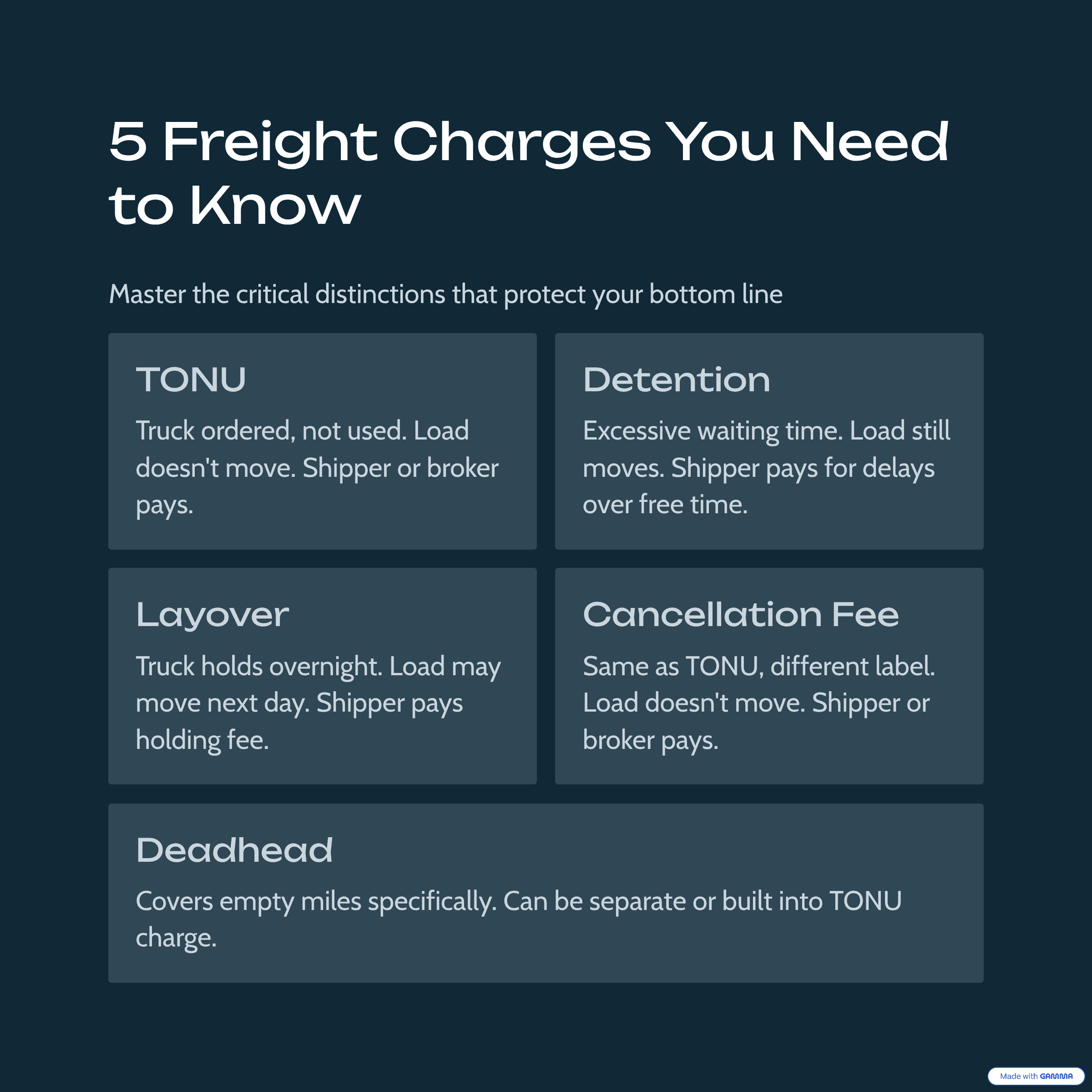
Detention applies when the load still happens but there's excessive waiting time at the facility. The truck eventually gets loaded and delivers. TONU applies when the load doesn't happen at all — the truck leaves empty.
The dividing line is simple: did the freight move? If yes, you're in detention territory. If no, you're looking at TONU.
TONU vs. Layover
Layover occurs when a delay forces the truck to stay committed into the next day or longer, and the load may still move eventually. TONU applies when the carrier is released entirely without loading. The distinction matters because layover implies the load is still alive; TONU means it's dead.
TONU vs. Cancellation Fee
Some broker-carrier agreements use the term "cancellation fee" instead of TONU. Operationally, it's the same concept as long as it's tied to a committed truck and non-use. The label doesn't change the obligation — what matters is the contract language and the facts.
TONU vs. Deadhead Reimbursement
Deadhead reimbursement covers empty miles specifically. It can be built into a negotiated TONU flat fee, or it can be added as a separate line item — but only if that's agreed to in writing. If you don't define this relationship in your agreements, you're inviting disputes every time a carrier submits a TONU claim with deadhead tacked on.
When Is a Truck Considered "Ordered" — And What Does "Not Used" Actually Mean?
Most TONU disagreements aren't really about whether the charge is legitimate in principle. They're about where the line falls. Was the truck actually committed? Was the cancellation late enough to matter?
What "Ordered" Looks Like in Practice
A truck is generally considered "ordered" when the carrier has accepted the load, received a rate confirmation or written load terms, assigned a truck and driver (explicitly or implied through tracking or check calls), and begun traveling toward pickup or checked in at the facility.
All four indicators don't need to be present in every case, but the more boxes that are checked, the stronger the carrier's position.
What "Not Used" Means Operationally
The truck either arrived at the facility and could not load, or was en route and got canceled late enough that the carrier incurred meaningful cost and lost the opportunity to book elsewhere.
The Timing Threshold That Changes Everything
The single biggest variable in any TONU claim is when the cancellation happened relative to the pickup appointment, the driver's check-in time, the "last free cancellation time" (if your agreement defines one), and the dispatch start time.
A cancellation 12 hours before appointment with no truck dispatched is very different from a cancellation 30 minutes before pickup with a driver already at the gate. Your agreements need to reflect this.
Common TONU Trigger Scenarios
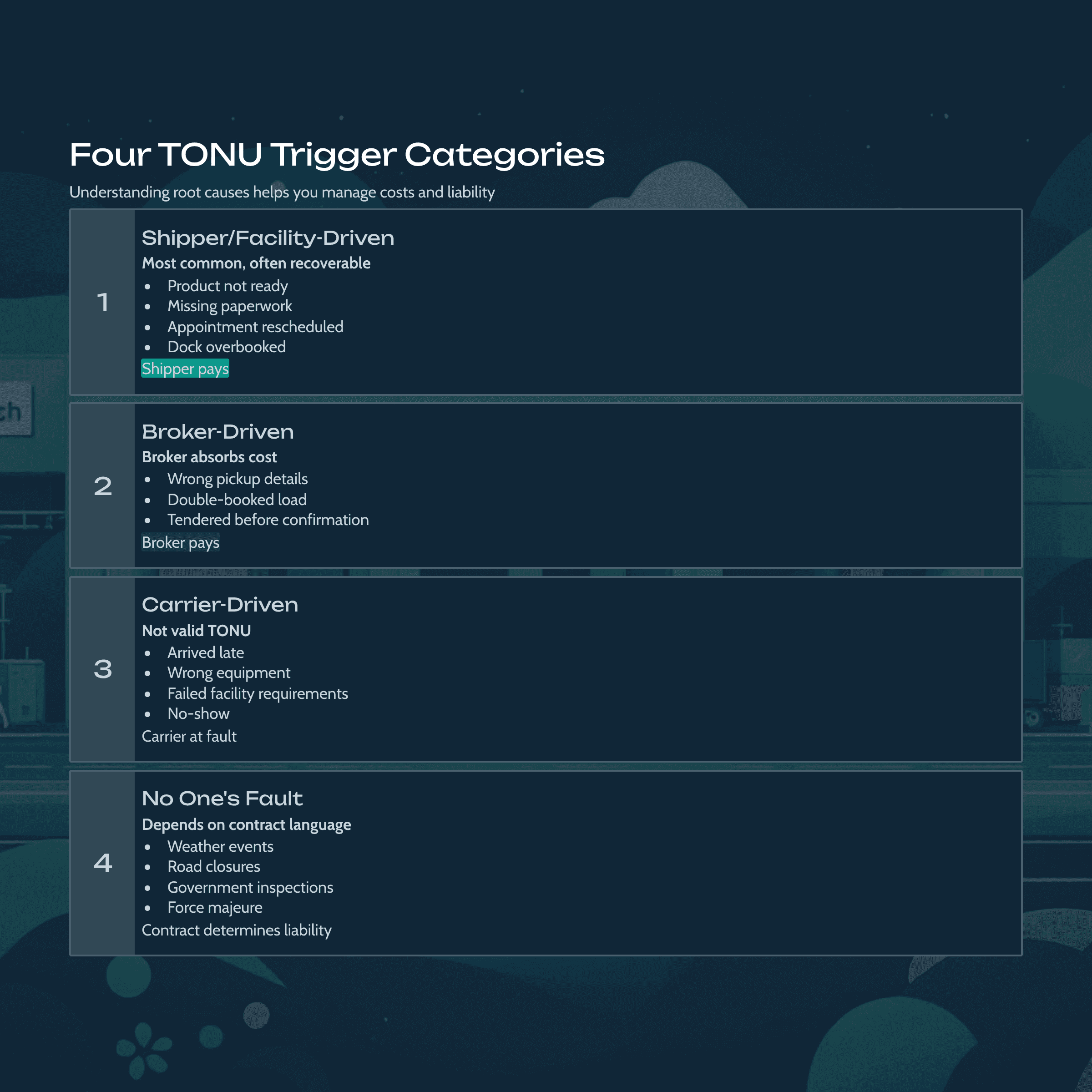
Not every TONU situation looks the same, and how you handle each one depends heavily on who controlled the outcome.
Shipper and Facility-Driven Scenarios
These are the most common TONU triggers, and they're often recoverable from the shipper if you've documented them properly.
The load gets canceled because product isn't ready. The facility refuses to load because of missing paperwork, a missed cutoff, a closed dock, a holiday closure, or a weight or pallet count mismatch the shipper won't correct. The appointment gets rescheduled after the truck is already committed and the carrier can't afford to wait. The dock is overbooked and there's no door or time slot available.
Broker-Driven Scenarios
When the TONU is the broker's fault, the broker usually eats the cost. This includes providing the wrong pickup number, wrong address, or wrong appointment time. It also includes double-booking a load (two carriers show up, one gets released) or tendering a load before the shipper actually confirmed product was ready.
Carrier-Driven Scenarios
These typically don't qualify as valid TONU claims. If the carrier arrived late outside the agreed pickup window, brought wrong equipment, failed to meet facility requirements like PPE or seal policies, or simply didn't show up, the carrier caused the problem. The exception is when a facility refuses a timely, compliant truck for reasons unrelated to the carrier's performance.
"No One's Fault" Scenarios
Weather, road closures, government inspections, and other force majeure events fall here. Whether TONU is owed in these situations depends entirely on what your agreements say. If your contract is silent on force majeure, you're negotiating from scratch every time.
What Proof and Documentation Brokers Should Request
Documentation is the difference between a clean TONU resolution and a weeks-long dispute. Here's what you should be collecting and why.
Minimum Documentation Checklist
Written confirmation of cancellation or refusal. This means either a message from the broker to the carrier releasing the truck, or a facility refusal statement if you can get one.
Timestamped location proof. A tracking ping near the facility, a signed check-in or check-out time, or a photo of facility signage with geo metadata if available.
Driver notes. Who they spoke with, what was said, what was refused, and when. This should be captured while the details are fresh — within hours, not days.
Appointment details. The scheduled time, actual check-in time, and outcome.
Proof That's Nice to Have
A facility "empty call" stamp or signed note strengthens any claim, though many warehouses refuse to sign anything for a canceled load. Gate log screenshots, check-in kiosk receipts, and call recordings or written recaps (where permitted by local rules) all help reduce disputes.
The Documentation Reality
Here's the truth: many warehouses will not sign carrier paperwork for a refused or canceled load. Brokers who demand signatures in every case will delay resolution indefinitely. The better approach is a tiered proof standard — tracking data plus timestamps plus driver notes can be enough to verify a legitimate claim without waiting for a signature that's never coming.
How to Verify TONU Claims (And Avoid Paying Invalid Ones)
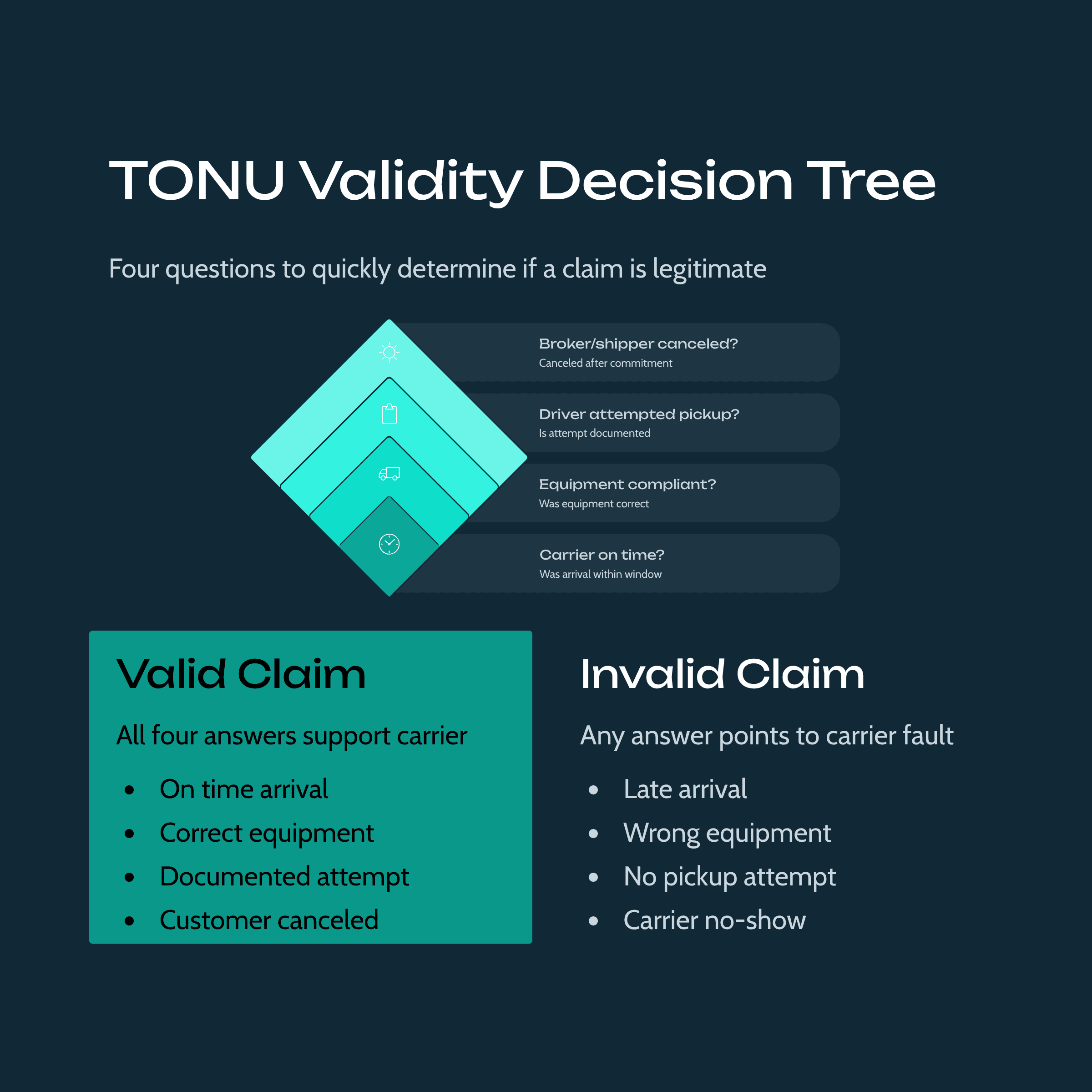
Fast Triage: The Four Questions
Before you dig into any TONU claim, answer these four questions. Was the carrier on time relative to the pickup window? Was the equipment compliant with what was booked? Did the driver actually attempt pickup, based on location and time evidence? Did the broker or shipper cancel after the carrier was committed?
If any of those answers point to carrier fault, the claim is likely invalid.
Confirming Fault Without Starting a Fight
Compare the rate confirmation requirements against shipper instructions, the facility rules that were communicated to the carrier, and the actual arrival and check-in timeline. Discrepancies tell the story. You don't need to accuse anyone — the timestamps and documents either support the claim or they don't.
Red Flags That Require Escalation
Escalate when the carrier can't provide any time or location proof, when the timeline has inconsistencies (arrival times that shift, vague answers about who they spoke with), or when the carrier requests TONU despite being late or non-compliant. These situations need a second set of eyes before you pay.
How to Write TONU Into Your Broker-Carrier Agreements
This is where most brokers fail. Vague language creates inconsistent enforcement, which creates disputes, which create payment delays, which damage carrier relationships. Write your TONU terms clearly once and enforce them consistently.
Where TONU Terms Should Live
TONU terms belong in three places: your broker-carrier agreement (the master terms), the rate confirmation (which can override master terms on a load-by-load basis), and an internal SOP that your team follows consistently so the policy actually gets applied.
Clause Components That Remove Ambiguity
A strong TONU clause addresses seven things.
Trigger condition — cancellation or refusal after the truck is committed or has begun rolling.
Timing rule — cancellation within X hours of the appointment, or after dispatch has started.
Documentation required — a specific list of acceptable proof types so carriers know what to submit.
Exclusions — late arrival, wrong equipment, no-show, failure to follow instructions. Spell out what doesn't qualify.
Payment amount — a flat fee or a tiered schedule based on the circumstances.
Submission deadline — carriers must submit the TONU request within X hours or days. Without a deadline, you'll get claims showing up weeks later with no supporting detail.
Non-stacking rule — clarify whether TONU can stack with detention, layover, or deadhead reimbursement. If you don't address this, carriers will try to combine charges.
Example Tiered TONU Schedule
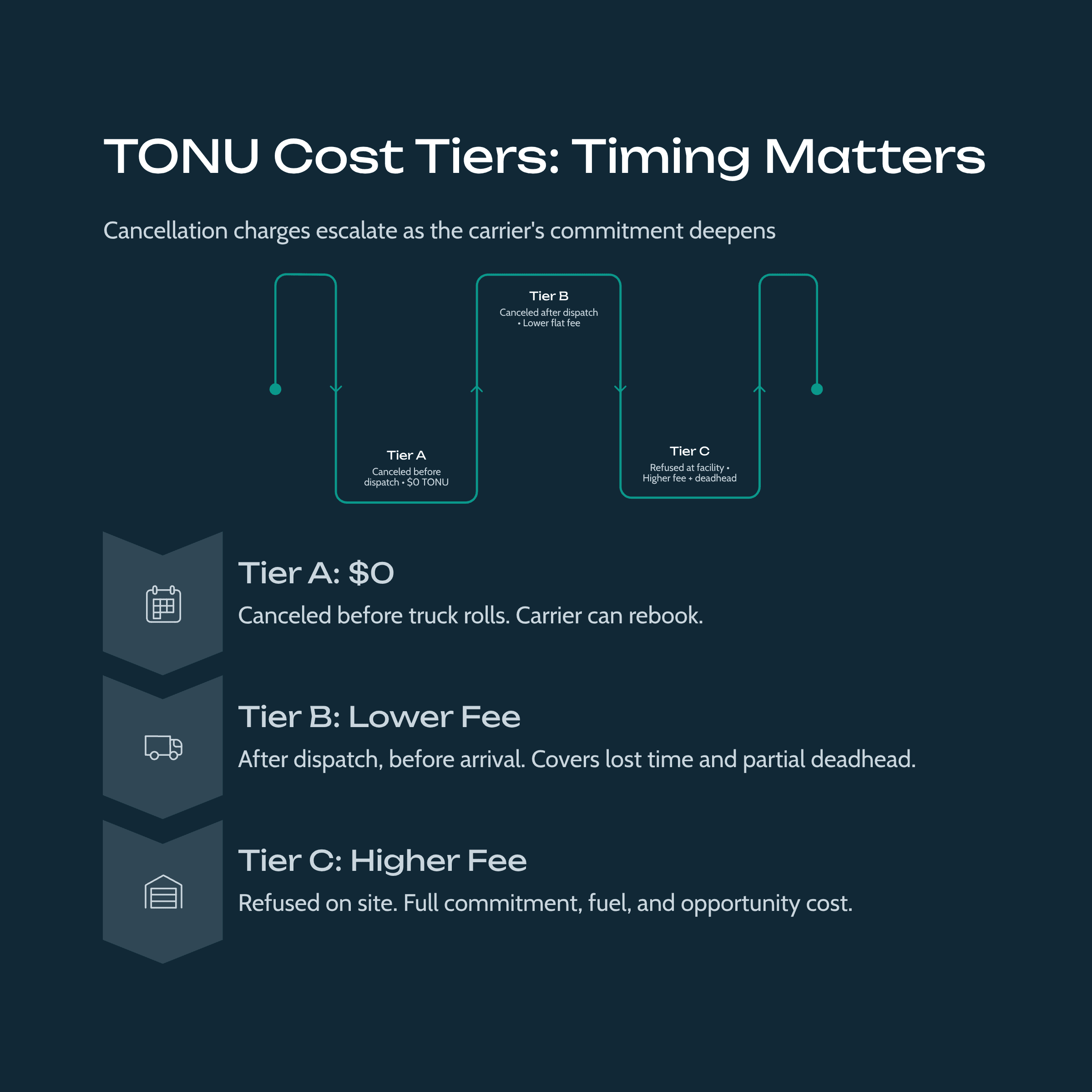
This isn't a universal standard — it's a framework you can adapt to your operation.
Tier A: Canceled well before the appointment and before the truck rolls. Typical TONU: $0. The carrier had time to rebook.
Tier B: Canceled after dispatch but before the truck arrives at the facility. Typical TONU: a lower flat fee that acknowledges the lost time and partial deadhead.
Tier C: Refused at the facility after the carrier checked in on time. Typical TONU: a higher flat fee reflecting full commitment, fuel, and lost opportunity.
Optional add-on: Deadhead mileage reimbursement, but only when agreed in writing and documented with location evidence.
How Brokers Actually Recover TONU From Shippers
The Recoverability Problem
Brokers can only reliably invoice and collect TONU from a shipper when two conditions are met: the shipper agreement allows it, and the broker can demonstrate that the shipper's action (or the action of a facility under the shipper's control) caused a committed truck to go unused. Without both, you're absorbing the cost.
What to Include in Customer Agreements
Your shipper-facing agreements should include cancellation windows tied to pickup appointments, a definition of what constitutes a "committed truck," a required notice method for cancellations (email, portal, or other time-stamped communication), agreement on what proof is acceptable (since facility signatures are often unavailable), and clarity on whether TONU is passed through at cost or includes an administrative fee. Be careful with markups — hidden fees create trust issues that can cost you the account.
Invoicing That Reduces Disputes
Invoice TONU as a separate line item, never buried in linehaul. Include the date and time of cancellation, the original appointment time, a summary of proof collected, and the facility name and pickup reference number. Shippers are far more likely to pay a TONU invoice that's clean, specific, and backed by a clear paper trail.
End-to-End TONU Workflow for Freight Brokers
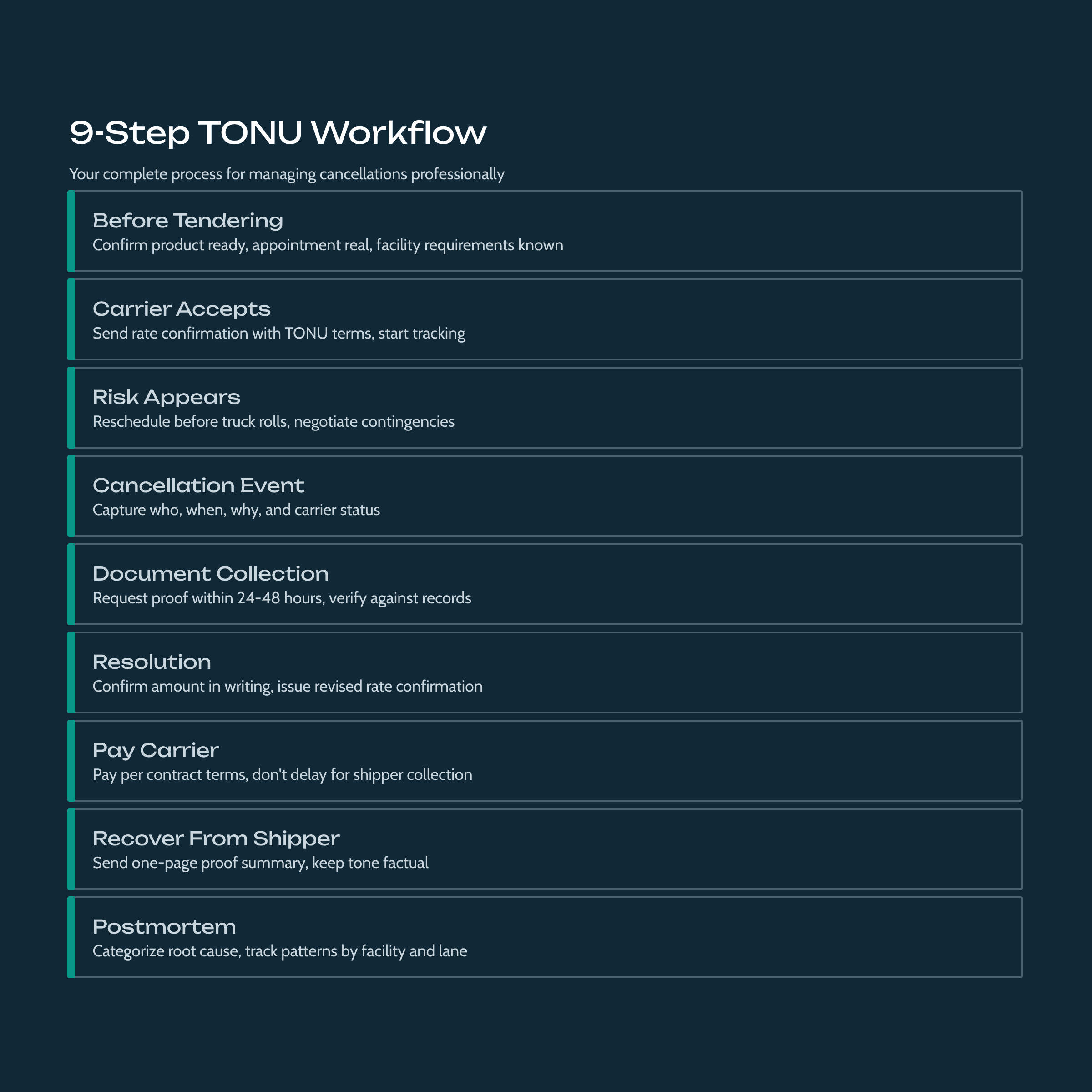
Step 1: Before Tendering the Load
Prevention starts here. Confirm that the product is ready, the pickup appointment is real and confirmed (not tentative), facility requirements are known and communicated, and document the confirmation in writing. This single step eliminates a significant share of TONU incidents.
Step 2: When the Carrier Accepts
Send the rate confirmation with the pickup window and appointment details, your TONU terms or a reference to your master agreement, and the required check-in procedure. Start tracking visibility early enough to prove dispatch and arrival if needed later.
Step 3: When Cancellation Risk Appears
If the shipper hints at a delay, try to reschedule before the truck rolls. Proactively negotiate what happens if the truck arrives and can't load. The goal is to address the problem before it becomes a TONU event.
Step 4: When the Load Is Canceled or Refused
This is the critical hour. Immediately capture who canceled (shipper, facility, or broker), the exact time and reason, and whether the carrier is on site or en route. Tell the carrier clearly whether they're "released" or should "stand by." Ambiguity here creates layover claims on top of TONU.
Step 5: Document Collection and Verification
Request documentation within a defined time window — 24 to 48 hours is standard. Verify everything against tracking data, appointment records, messages or call logs, and facility notes.
Step 6: Resolution and Paperwork
Confirm the TONU amount in writing. Issue a revised rate confirmation or written accessorial approval. Make sure your billing system flags the charge as TONU, not linehaul. This matters for margin reporting and audit trails.
Step 7: Paying the Carrier
Pay per your contract terms. Don't delay payment because you're still collecting from the shipper unless your agreements explicitly allow that. Slow-paying legitimate TONU claims damages your reputation with carriers and makes it harder to cover loads in tight markets.
Step 8: Recovering From the Shipper
Provide a one-page proof summary. Keep the tone factual, not emotional. If the shipper disputes, offer the timeline, show the agreement language, and only propose a courtesy credit if it protects a larger account relationship — and use that move sparingly.
Step 9: Postmortem
Categorize the root cause: shipper readiness, appointment integrity, broker process failure, or carrier compliance failure. Track patterns by facility and lane. Repeat TONU at the same location is a process problem, not bad luck.
How to Set TONU Amounts Without Making Enemies
What TONU Is Actually Compensating
When you're negotiating TONU amounts — either setting policy or handling a one-off claim — anchor to the three real costs: time committed, empty miles driven, and the lost booking opportunity. These are concrete, defensible, and hard to argue with.
Negotiation Principles
Be consistent across carriers. If you pay $250 TONU to one carrier for a Tier C refusal, you should pay $250 to the next carrier in the same situation. Inconsistency breeds resentment and dispute volume.
Pay more when the proof is strong and the impact is high — a carrier who arrived on time, checked in, and got refused has a stronger claim than one who was still 100 miles out. Pay less or deny when carrier non-compliance caused the failure.
Example Scenarios
Cancellation 30 minutes before appointment, truck already within 10 miles. The carrier has incurred dispatch costs, local deadhead, and lost a booking slot. This is a strong TONU claim — approve at your pre-agreed flat fee.
Cancellation 12 hours before appointment, truck not yet dispatched. The carrier hasn't incurred meaningful cost and still has time to rebook. This is typically a $0 TONU situation.
Handling TONU Disputes
The Four Disputes You'll See Over and Over
Almost every TONU dispute boils down to one of four arguments: "The truck didn't actually arrive," "The truck was late," "We never agreed to TONU," or "The shipper won't pay it." Each has a different response, but all of them are resolved with documentation, not debate.
A Resolution Framework
Acknowledge the carrier's request promptly. State the facts with timestamps. Reference the agreed terms from the rate confirmation or master agreement. Then offer a clear decision and next step — approve, deny, or counter with a specific amount and an explanation of why.
Don't ghost carriers on TONU claims. A fast "denied with reason" is better for the relationship than weeks of silence.
When to Escalate Internally
Involve a manager for high-dollar TONU requests, repeat-issue facilities, or situations with conflicting tracking evidence. If a carrier submits repeated invalid claims, address it through policy — a formal warning or carrier scorecard flag — not through emotion.
Compliance, Records, and Audit Trails
What to Store for Every TONU Event
For each TONU incident, keep the rate confirmation and any revisions, all cancellation messages, tracking evidence, carrier-submitted documentation, and the shipper invoice with the shipper's response.
Why This Matters
Accessorials are frequent audit targets because they directly affect margin and customer billing. Consistent TONU documentation protects you in chargebacks, customer disputes, and carrier payment disagreements. Treat your TONU records the same way you'd treat your load files — because in an audit, they'll be examined with the same scrutiny.
This guide is operational guidance for freight brokers, not legal advice. Consult qualified legal counsel for contract-specific questions.
How to Prevent TONU Before It Happens
Shipper Readiness Checklist
Before you tender any load, confirm four things: product is staged and ready, a pickup number has been created, the appointment is confirmed and a dock is available, and you know the facility's hours and check-in rules. This takes five minutes and prevents the majority of avoidable TONU incidents.
Broker Operations Habits That Cut TONU Frequency
Make early check calls before the truck rolls — don't wait until the driver is at the gate to find out the load isn't ready. Set clear go/no-go cutoff times so your team knows when to hold a tender versus release it. Never tender "maybe loads" where product readiness is uncertain. And document every change in writing, no matter how small.
Facility-Specific Playbooks
Some facilities are repeat offenders for last-minute refusals. Build facility notes that include typical wait times, check-in quirks, and the specific refusal reasons you've encountered before. Sharing these notes with carriers before pickup reduces surprises and prevents TONU events that are really just information gaps.
Metrics Brokers Should Track to Manage TONU as a Cost Center
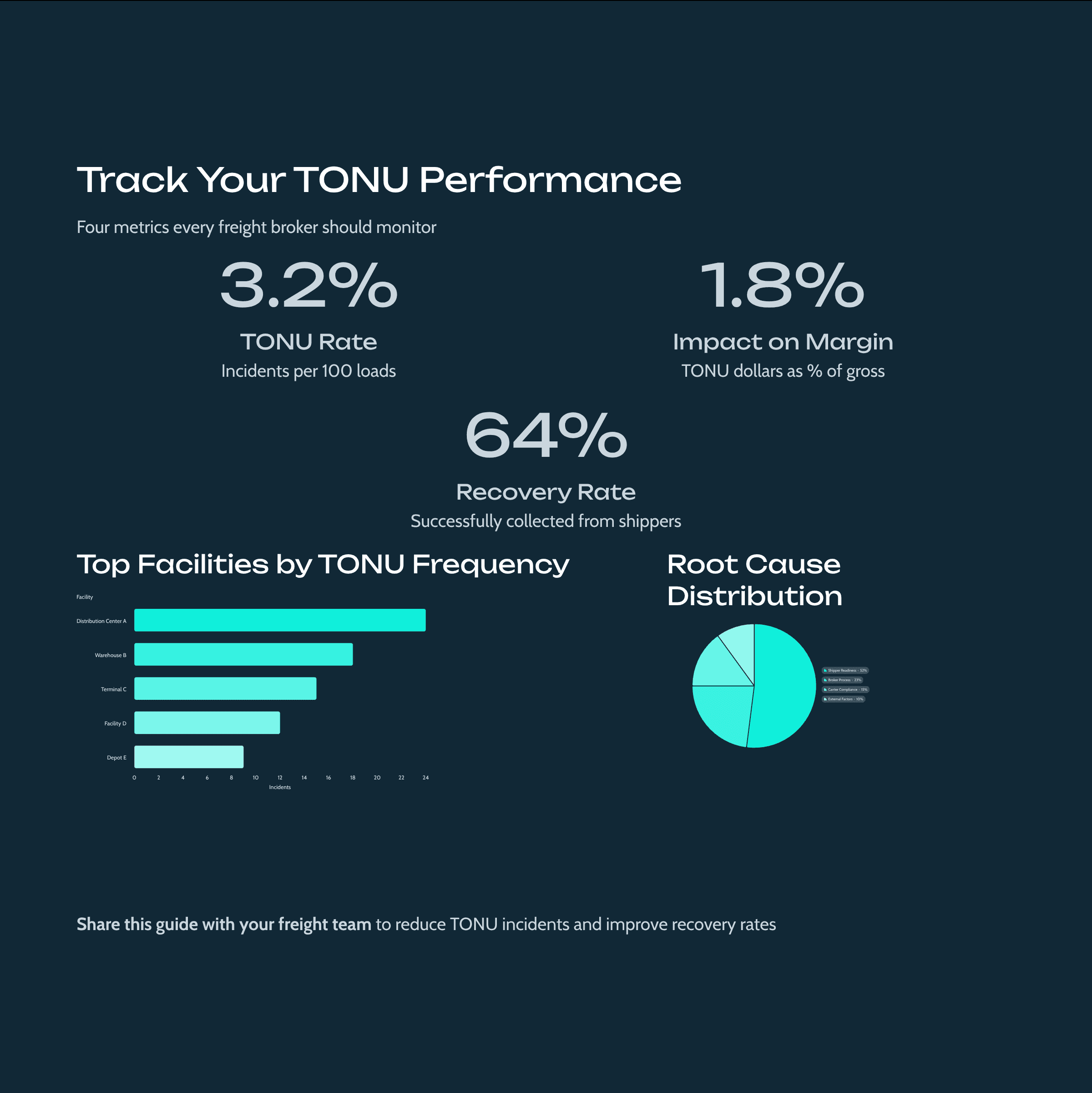
If you're not measuring TONU, you're not managing it. Four metrics give you a complete picture.
TONU rate — the number of TONU incidents per 100 loads. This tells you how often it's happening.
TONU dollars as a percentage of gross margin — this tells you how much it's actually costing you.
Recovery rate from shippers — the percentage of TONU charges you successfully collect from customers. If this number is low, your shipper agreements need work.
Top facilities by TONU frequency — this identifies the locations where the problem keeps repeating. If one facility drives 30% of your TONU, that's a conversation to have with the shipper, not just a cost to absorb.
Track root cause distribution across shipper readiness, broker process failure, carrier compliance failure, and external factors. Patterns in this data tell you where to invest in prevention rather than just managing claims after the fact.